
How Bench Warrants Work in Anderson County
People say "bench warrant" as shorthand for a court order that follows a missed appearance or another failure to comply. The local docket may use different words, such as FTA warrant, capias, or capias pro fine. Whatever the label, the Anderson County court that set the original case usually holds the record and decides what must happen next. So do not call a missed payment a bench warrant on your own. Check the case first. Anderson County's four JPs and three municipal courts handle many Class C and traffic matters. District and county courts handle the other criminal files. The simplest first step is the court printed on the notice you received.
Anderson County Bench Warrants, FTA, and Capias Differ
An FTA process follows a required appearance or response that did not happen. A capias pro fine is different. It is post-judgment process tied to unpaid fine and costs, issued after notice and a hardship process. Texas Chapter 45A adds recall provisions for certain justice and municipal court matters. Those apply when a person voluntarily appears and makes a good-faith effort to resolve the capias pro fine before execution.
- FTA warrant
- Process related to a failure to appear or respond as ordered.
- Capias
- A court order directing arrest and return to the issuing court.
- Capias pro fine
- Post-judgment process tied to a fine and costs, with specific hearing and recall rules.
Ask the clerk to read the exact docket label in Anderson County. A payment balance, collection notice, or license hold is not the same record.
Bench Warrant Issuance in Anderson County
It starts with an obligation the court sets, such as appearing on a docket or complying with an order. Chapter 45A spells out notice and procedural steps before certain FTA or capias-pro-fine process issues in JP and municipal cases. A judge or magistrate controls the order. The Anderson County Sheriff's Office or another authorized peace officer may serve it. A clerk can explain the docket but cannot decide whether to recall it. After issuance, the right Anderson County contact still depends on venue. A city ordinance case stays with its municipal court, while a felony file runs through the Anderson County District Clerk. There is no single public portal here that proves every lower-court warrant status.
A Missed Anderson County Court Date Can Lead to a Warrant
JP4 publishes a local example worth reading. A person seeking a driver-safety course must meet the court's proof and completion rules. Missing required documents can lead to a show-cause setting. Fail to appear there, and the result can be judgment plus a capias pro fine. That is a court process, not a general driver-record lookup. Call the precinct that handled the citation before paying through a vendor. Ask whether the matter sits at the course stage, has a hearing date, or has become post-judgment process, because the court can tell you whether payment alone changes the warrant status. The JP4 traffic guidance lays out this sequence.
How Bench and Arrest Warrants Differ
Both kinds can authorize an arrest. The triggers differ, though. An initial arrest warrant follows a criminal complaint or other probable-cause basis, while a bench or FTA warrant follows a court obligation that was missed or unmet. Use the exact case label, contact the issuing court, and see the Anderson County arrest-warrant page for the initial criminal process.
| Question | Bench or FTA process | Initial arrest warrant |
|---|---|---|
| Why issued? | Missed setting, response, or court duty | Criminal complaint and probable-cause review |
| Who controls next step? | The court that set the case | The issuing court or magistrate |
| Useful first contact | Issuing clerk, then Sheriff Warrants if county-held | Issuing court and the agency serving process |
Palestine Has Published FTA Options
Palestine Municipal Court tells a person with an FTA warrant to call the clerk at (903) 731-8433 or appear at a court docket. Capias-pro-fine matters get treated separately, with show-cause or payment options. The FAQ also describes a possible community-service route under Standing Order No. 2017-1. It can apply to someone who voluntarily appears, cannot pay at once, and has not previously been ordered to perform service in that case. Eligibility is the court's call, not a promise that service is automatic or that walking in is risk-free. One more Anderson County note: since August 1, 2026, the city says appearances are in person unless the court directs otherwise. Follow the official city warrant instructions for the details a Palestine case needs.
Clearing a Bench Warrant in Anderson County
Call the issuing clerk first. Ask whether the warrant is active, whether a voluntary appearance or docket setting is allowed, whether an attorney can arrange a walk-through, and what payment or hearing would address the order. For a felony or other criminal case, talk to a Texas attorney before appearing. Anderson County publishes no universal recall form. There is no safe-surrender window either.
Payment is not always recall. A receipt may show that a balance was paid, while the court record still needs a recall order or a new setting. Ask what confirms the warrant itself is cleared.
Facing a capias pro fine in an Anderson County JP or city case? Ask the clerk about hardship and show-cause procedures under current Chapter 45A. The law and the court file decide the options, not a general payment page.
Four Anderson County JPs Hold Separate Cases
Use the precinct printed on the citation. Each Anderson County Justice of the Peace keeps its own clerk, hours, and payment route. JP3 sits at the courthouse, JP2 and JP4 in the Mallard Street annex, and JP1 in Elkhart. A city court is a separate route from the nearby JP.
| Court | Address | Phone |
|---|---|---|
| JP1 | 120 Watkins St., Elkhart | (903) 764-5661 |
| JP2 | 703 N. Mallard, Suite 107, Palestine | (903) 723-7486 |
| JP3 | 500 N. Church St., Suite 8, Palestine | (903) 723-7418 |
| JP4 | 703 N. Mallard, Suite 106, Palestine | (903) 723-7419 |
Official contact panels are available for JP2 and JP3.
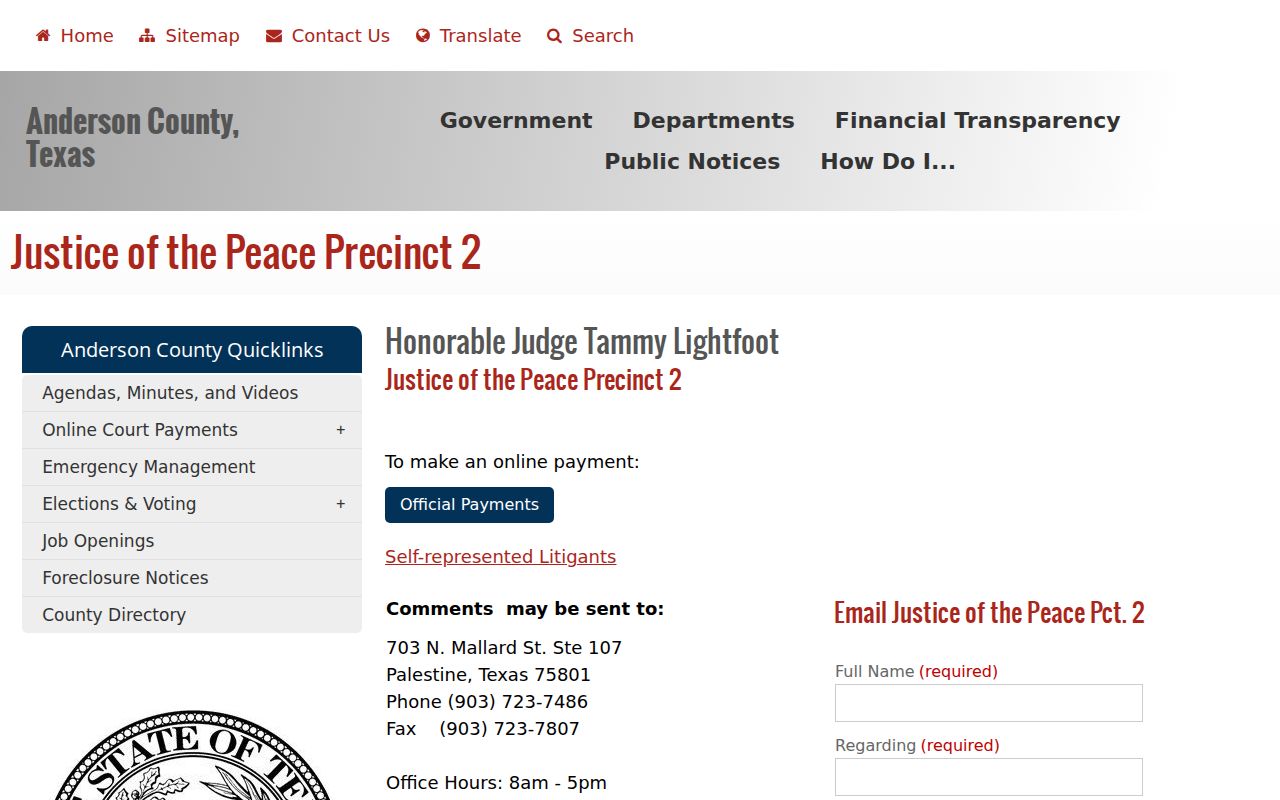
The JP2 panel lists its own Anderson County office and payment link, separate from neighboring courts. The JP3 contact page gives its courthouse suite and precinct phone.
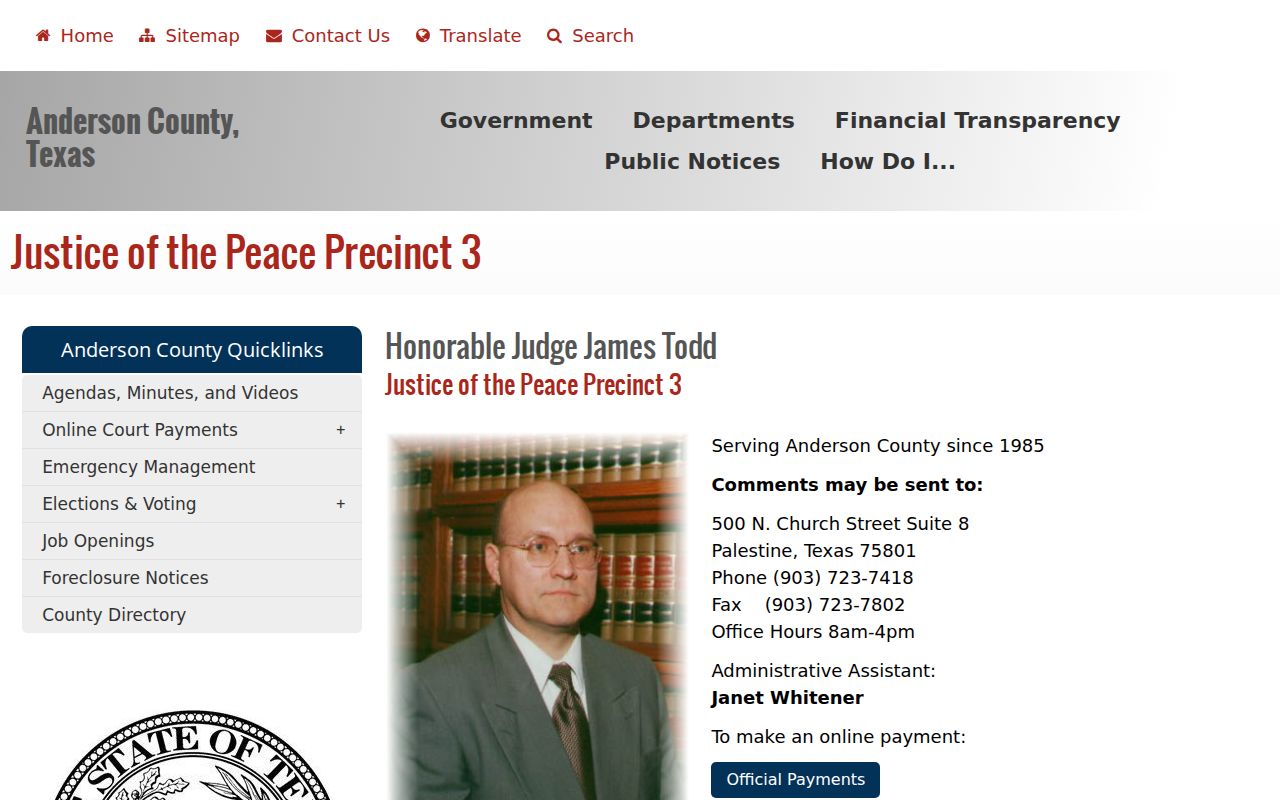
The JP3 suite number is worth knowing in Anderson County, since four separate justice courts each hold their own dockets.
Anderson County Courts That Issue Bench Warrants
Figuring out which court issued a bench warrant in Anderson County starts with the paperwork you already hold. Felony filings run through the Anderson County District Clerk, while County Court at Law files may sit with either the Anderson County Clerk or the District Clerk, depending on jurisdiction. Anderson County Court at Law sits at 500 N. Church Street, third floor, and answers at (903) 723-7469. For district coordinator questions, the county lists (903) 723-7414. When you call, bring the cause number and name the court printed on the notice, because the courthouse houses several separate offices. Those include the Anderson County Sheriff's Civil/Warrants room, clerk counters, JP3, and county court. The courthouse directory and the County Court at Law page show where each office sits and route calls to the right desk.
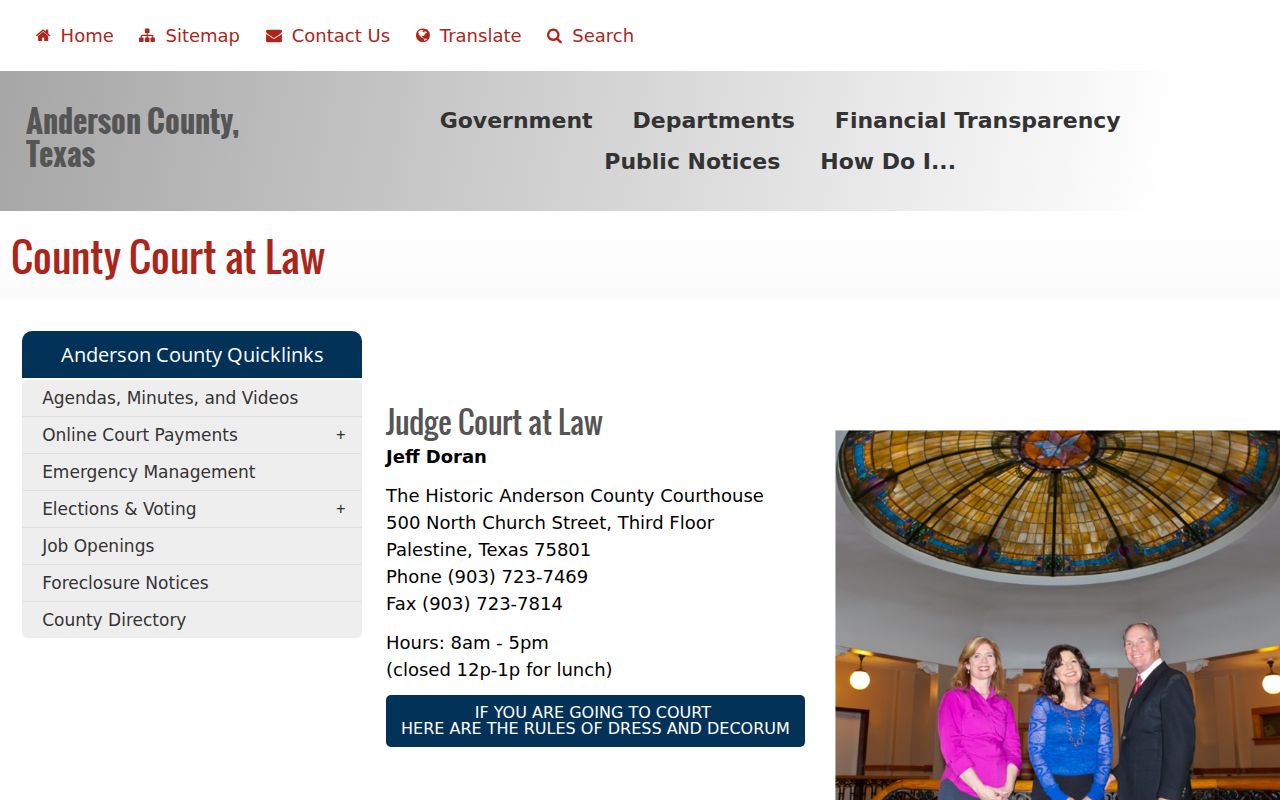
The Anderson County court page spells out its jurisdiction and why different clerks may hold the same type of case.
Anderson County Warrant Resolution Has No Safe-Surrender Window
The Anderson County Sheriff's page names a Warrants line and courthouse Room 12. It posts no walk-in surrender hours, jail intake rules, or after-hours procedure. Call (903) 731-8243 before going in person. Ask whether the issuing court, the Sheriff Civil Division, or the jail is the right stop, and whether a lawyer should arrange the appearance. A bond is separate from the underlying case. Paying it does not close the matter. Anderson County has a Bail Bond Board but posts no countywide bond schedule. The issuing court or the jail can explain personal, cash, or surety bond instructions and the next court setting.