
Anderson County Warrant Checks
Anderson County has no single search covering every court, so start with the office named on your citation or notice. For a county matter, call the Anderson County Sheriff's Civil Division/Warrants line at (903) 731-8243. Felony files belong to the Anderson County District Clerk, while a county-level case may sit with the Anderson County Clerk. Got a city citation? Take it to the municipal court that issued it. Before you call anyone, gather a full name, date of birth, case or citation number, and the city or precinct involved. Even a solid match is just a lead. Ask the issuing office directly whether the warrant is active and what step clears it.
- Call Anderson County Sheriff's Warrants line for county-held process and ask which office has the case.
- Contact Anderson County District Clerk or County Clerk for a district or County Court at Law file.
- Call Anderson County JP or city court printed on a traffic or Class C citation.
- Use a county-linked case portal only for the court and case types it covers.
- Before appearing or paying, confirm the court's current instructions and ask about counsel if needed.
Anderson County Has No Countywide Warrant Roster
Anderson County Sheriff's Office publishes a Warrants phone number, but its official page offers no searchable name list, no downloadable roster, and no warrant results table. That limit is real, though it proves nothing either way about any particular warrant. The phone line and the issuing court remain the dependable status checks. For records tied to a case, the Sheriff's Records Department takes written requests by email or letter at 1200 E. Lacy Street in Palestine. Name the case, date range, or agency you want searched. Anderson County posts no warrant-specific fee or processing time, and the office will not build a new countywide list on request. The county's official Sheriff contact page shows both the Civil Division/Warrants function and a separate Records contact, so treat them as two different services: one answers warrant questions, the other handles written record requests.

The image shows Anderson County's official warrant contact information, not a public name-search list.
Warrants in Anderson County: The Main Types
The label on an Anderson County court file matters. An arrest warrant usually starts with a sworn complaint and a probable-cause review. Miss a court date and a bench warrant, also called failure to appear, may follow. A capias pro fine comes after judgment, tied to an unpaid fine and costs once required safeguards are met. A search warrant lets officers look for specified evidence. It is not a tool for checking your own name.
| Process | Typical local route | What to confirm |
|---|---|---|
| Arrest warrant | District, County Court at Law, JP, or municipal judge by case | Issuing court, status, and bond instructions |
| FTA or bench warrant | The court that set the missed appearance | Whether a docket or voluntary appearance is available |
| Capias pro fine | JP or municipal court after judgment | Hearing, hardship, payment, or other court order |
| Search warrant | Judge or magistrate with authority | Do not confuse with an arrest-warrant lookup |
Courthouse Rooms Route Anderson County Warrant Records
One old building holds most of the paper. The courthouse at 500 N. Church Street in Palestine routes warrant records through a handful of separate doors. The Anderson County Sheriff's Civil Division/Warrants office sits in Room 12. The Anderson County Clerk works out of Room 10, and the Anderson County District Clerk is in Room 18. JP3 occupies Suite 8, while Anderson County Court at Law takes the third floor. A room number helps you call or visit the right desk. It does not merge these offices into one warrant database. Hours and services differ from office to office, so confirm before you drive over. The county sitemap sorts the clerk, court, sheriff, constable, and JP pages into their own listings. The county home page posts courthouse contacts alongside links to case records and court payment tools. That same Anderson County home page is the official page behind the courthouse contact and portal links.

The courthouse contact identifies the Anderson County setting. The case itself still decides which counter holds the file. The County Clerk's office page names its criminal deputies and posts a public-information form.
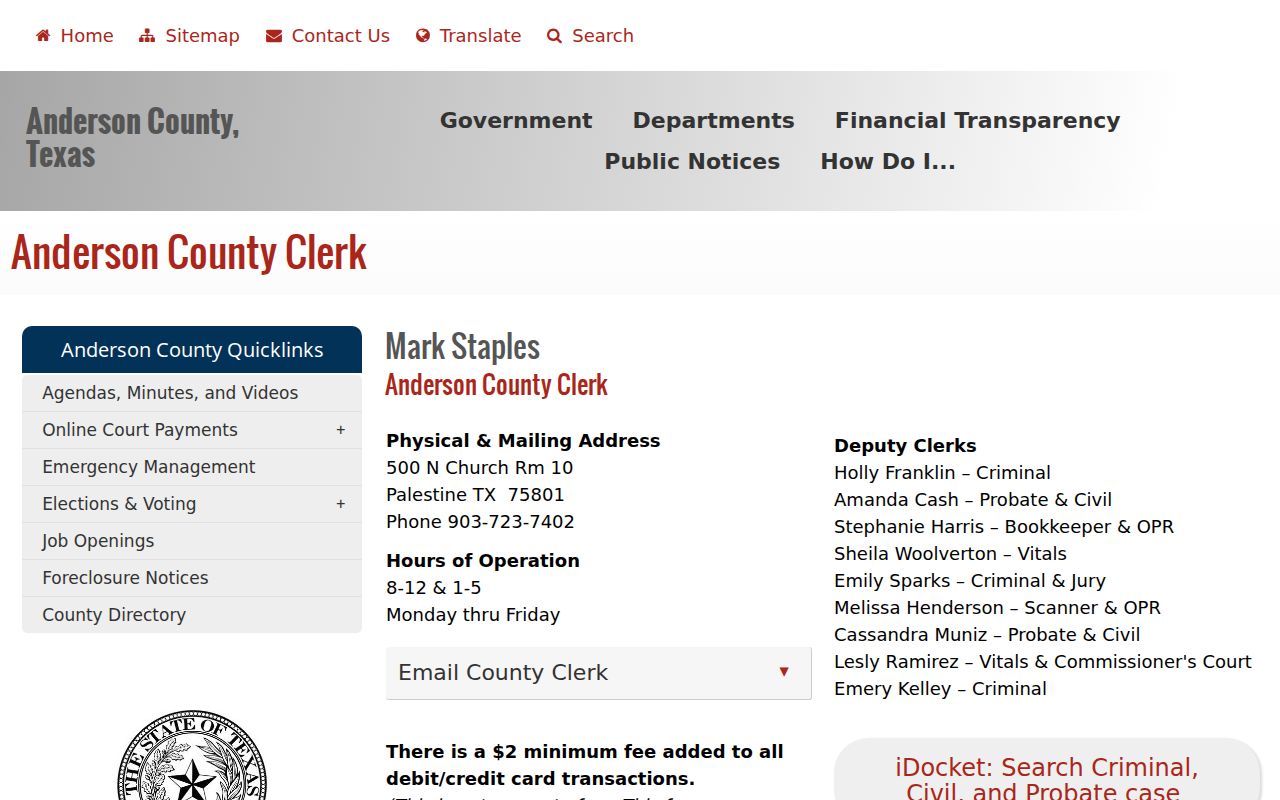
Anderson County Clerk's page offers its own public-information form and criminal-deputy route.
Anderson County Warrant Records: What They Show
No standard Anderson County warrant record appears in the public tools. A clerk or a released record may show the court, case number, process type, issue or recall date, charge category, and bond information. Fields can be missing or withheld. Ask the issuing court to explain its exact status label. A payment or setting may have changed the warrant itself.
| Case number | The cause or citation identifier used by the court and payment portal. |
|---|---|
| Issuing court | District Court, County Court at Law, a JP precinct, or a city court. |
| Process type | Arrest warrant, FTA process, capias, or capias pro fine as labeled by that court. |
| Status and date | Current activity must be confirmed with the issuing clerk; no countywide update legend is published. |
| Bond or amount due | Do not infer a bond from a fine or payment portal total. |
Anderson County Court Portals Search Cases, Not Every Warrant
Anderson County links Tyler Public Access and Research Texas for public case research. County Court and District Court Municipal Online Services offer case-number, name and date-of-birth, driver's-license, plate, and business-name routes. They are case or payment tools, not a complete warrant index. Do not enter a full Social Security number into an ordinary email or a site whose address you have not verified.
The Tyler Public Access portal is Anderson County's case-record link; Research Texas is a statewide case-search fallback. If a page fails to load or shows no match, ask the clerk rather than treating the result as a clearance.
Anderson County Warrants: Who Issues, Who Serves
Judges and magistrates issue process within their own court authority in Anderson County. The District Courts handle felony filings, and Anderson County Court at Law holds county-level criminal jurisdiction. JPs take precinct Class C and traffic matters. Municipal courts cover city ordinance and qualifying Class C cases. The Anderson County Sheriff's Civil Division, constables, and city police may serve the process, depending on the court and the assignment.
Anderson County Sheriff's Civil Division, Warrants
500 N. Church Street, Room 12
Palestine, TX 75801
(903) 731-8243
For an Anderson County file, the District Clerk keeps felony criminal filings and the County Clerk handles county-court records. A clerk can tell you where a case sits. Only the judge controls a recall or a setting.
Palestine's Warrant PDF Is a City List
Palestine Municipal Court links an active-warrant PDF from its warrant page. The page also explains FTA and capias pro fine options. Read the file as a city list. It is not an Anderson County inventory. Check the file's date before you rely on it. Use the Palestine Municipal Court warrant page as the official source, then call the clerk at (903) 731-8433 to confirm current status. Elkhart and Frankston publish no comparable public roster. Only the city court can explain the next step.
Handling an Anderson County Warrant
Call first. Contact the issuing court or the Anderson County Sheriff's Warrants line before you plan any appearance. Ask what kind of order it is: an FTA arrest warrant, a capias pro fine, or something else. Ask whether a docket setting, a voluntary appearance, or an attorney-arranged date is open to you. Felony or uncertain cases call for a Texas criminal-defense attorney who can ask about recall, surrender, or bond. Anderson County publishes no safe-surrender window and no complete bond schedule.
Before you go: A phone call does not promise immunity from arrest. Confirm where to appear, whether counsel should arrange it, and what proof shows the court recalled the warrant.
Start at the clerk's counter. A Palestine municipal FTA goes through the clerk or a court docket. For a capias pro fine, ask about the show-cause process and any options tied to your case. Keep payment receipts, and get separate word that the Anderson County warrant was recalled and when the next case date is set.
OmniBase Is Not an Anderson County Warrant Search
No statewide Texas directory consolidates warrant records from every local court. OmniBase comes closest. DPS's Failure to Appear/Failure to Pay program uses it to report unresolved violations from participating courts for license-renewal compliance. The company says its service is not a warrant database and does not include every court. A renewal hold is not a warrant. It flags license compliance, not warrant status. Ask the court that reported the event what must be done, and whether an appearance is required. DPS says a court-reported record update generally takes three to five business days after action, though the issuing court in Anderson County remains the source for warrant status. See the OmniBase explanation and the DPS program page.
Warrant Record Access Under Texas Law
Texas records law opens what already exists. The Public Information Act covers existing public records held by government offices, subject to exceptions. Requests to the Anderson County Sheriff's Records Department must be written. Email or letter both work. The Anderson County Clerk, District Clerk, city offices, and courts handle the records they hold. Name the court, case number, date range, and record type rather than asking an agency to build a new list.
Access rules:
Texas Government Code § 552.021 makes public information available, subject to confidentiality and exceptions.
Section 552.108 can protect some law-enforcement or prosecution information.
Texas Family Code § 58.010 makes a child's arrest warrant and supporting complaint confidential, subject to listed disclosures.
Some Anderson County files stay closed. Sealed filings, juvenile material, social-security numbers, victim details, and active investigations may be limited. A missing public result can mean another court holds the file or the record is restricted; it does not settle status.
Anderson County Has No General Warrant Amnesty
Anderson County has no general warrant amnesty. None of its official county, sheriff, clerk, JP, or city pages publish a countywide amnesty day, fee-waiver calendar, or safe-surrender event. A payment portal is not amnesty. Neither is a Crime Stoppers tip line. What you can do depends on the issuing court and the type of process. Palestine offers specific routes, including a show-cause hearing and a limited community-service option under Standing Order No. 2017-1 for some capias-pro-fine cases. The court decides who qualifies. Chapter 45A also spells out notice, voluntary-appearance, hardship, and recall rules for JP and municipal cases, so ask how they apply to your file.
Anderson County JP Warrants Follow Precinct Routes
Anderson County warrants live in four separate Justice of the Peace offices. Each keeps its own contacts and payment routes. JP1 sits in Elkhart, JP2 in Palestine, and JP3 at the Anderson County courthouse. JP4 publishes its own driver-safety-course guidance and a split-hour schedule. Read the precinct label on your ticket. One JP page cannot speak for another court's warrants. When a case portal says nothing about an active warrant, call that precinct's clerk. The Anderson County sitemap links every precinct alongside the clerk, court, sheriff, and constable offices.
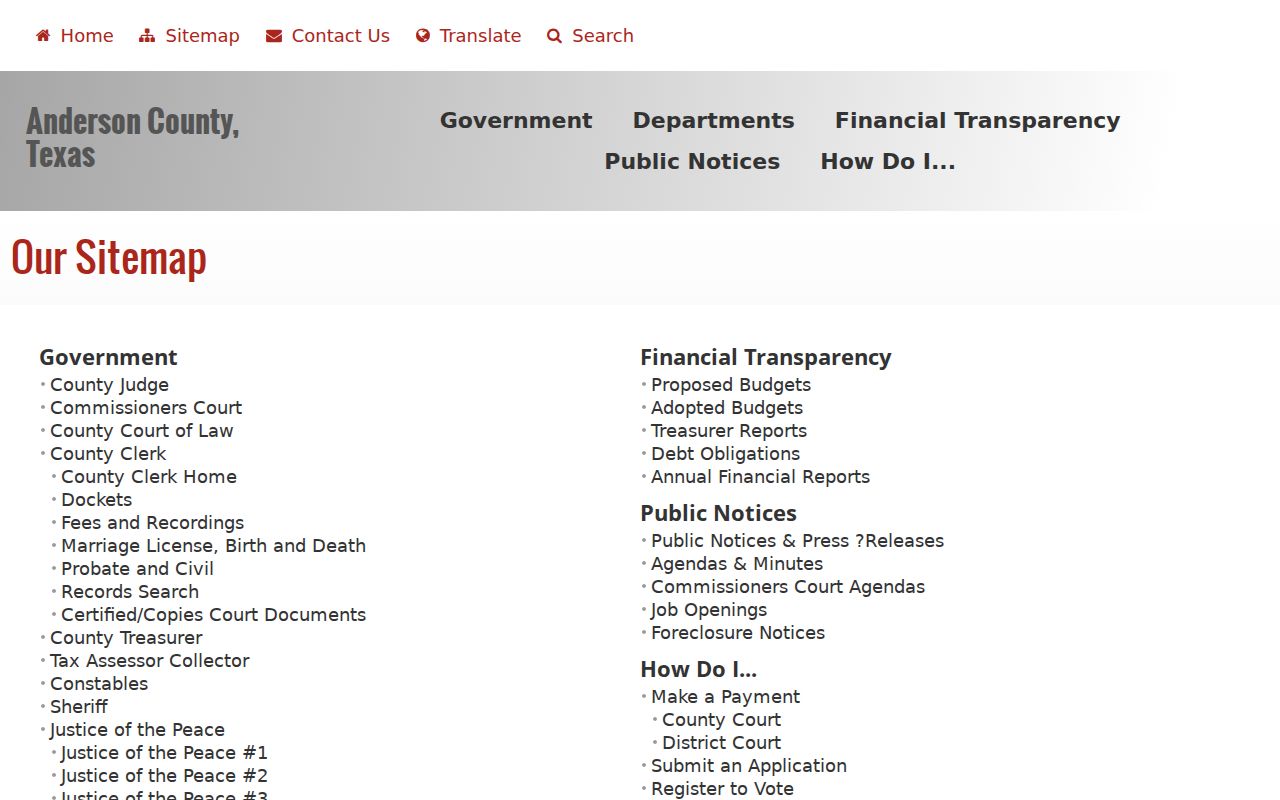
The Anderson County directory helps route a question to the right precinct, but it is not a warrant roster.
City Warrant Records in Anderson County
Anderson County has three incorporated places. Palestine posts a municipal warrant page with a linked PDF. Elkhart sends residents through City Hall and its City Secretary, while JP1 serves as a separate precinct court. Frankston lists an nCourt payment route and a police contact but no name-search warrant roster.